The Dark Patterns Tax: Why Deceptive CRO Costs More Than It Makes
Dark patterns make your conversion rate go up and your business go down. Why deceptive CRO wins the test, loses the customer, and now invites regulators, plus the honest alternative.

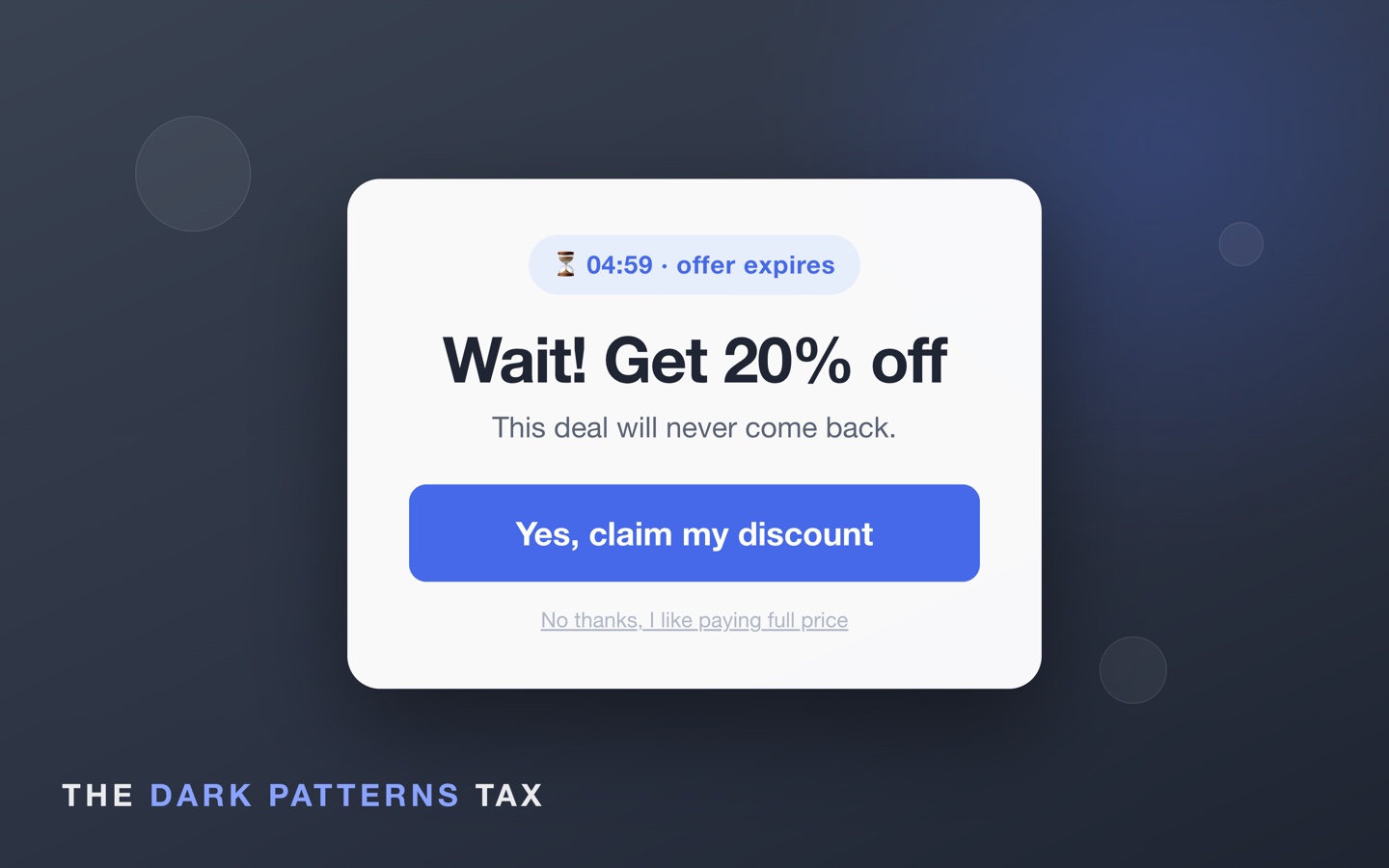
There is a whole category of "conversion tactics" that are really just lies with a nice UI. The industry calls them dark patterns. They are the fastest way to make your conversion rate go up and your business go down.
You already know them when you see them. The countdown timer that resets when you refresh. "Only 2 left!" on something that never sells out. Shipping and taxes that appear only on the final screen. A cancel button buried three menus deep. A pre-ticked add-on. A "No thanks, I like paying full price" link designed to make you feel stupid for declining.
They are not rare. A crawl of about 11,000 shopping sites found dark patterns on roughly one in ten of them.1
Why teams keep using them
Because they work, in the narrowest possible sense. Dark patterns exploit real cognitive biases, and the short-term effect is large. In controlled experiments, mild dark patterns more than doubled the rate at which people signed up for a dubious service, and aggressive ones nearly quadrupled it.2
So here is the trap: in an A/B test scored on immediate conversion, a dark pattern will usually win. Teams do not adopt them out of malice. They adopt them because their own measurement rewards them for it.
The tax you do not see in the test
A conversion test optimizes a proxy, the immediate sale, for a goal, a profitable customer who stays. Everything depends on those two staying connected. A dark pattern is the single best way to break that connection.
A tricked customer converts, so the test records a win. Then they refund. They charge back. They open a support ticket. They leave a one-star review. They never buy again. None of that shows up in a two-week conversion test, and all of it shows up in the annual P&L. You did not increase revenue. You borrowed a conversion from the future and paid interest on it.
That is the dark patterns tax: the sale is booked, the cost is hidden, and your own experiment told you it was a win.
It is now a legal risk too
This used to be only a reputation problem. Not anymore. The FTC's 2022 staff report put dark patterns squarely in the enforcement crosshairs,3 and then made it concrete: the maker of Fortnite was ordered to pay 245 million dollars in refunds for using deceptive designs to trigger unwanted charges.4 In the EU, the Digital Services Act now bans interfaces that deceive or manipulate users outright.5 The "growth hack" is becoming a liability line item.
The honest version works better anyway
Here is the part most people miss: the legitimate psychology behind almost every dark pattern can be captured honestly, without the downside.
- Fake urgency → real deadlines and honest stock counts. Genuine scarcity persuades and is defensible.
- Drip pricing → all costs shown up front. This is honest and it reduces the surprise-cost abandonment that kills checkouts.
- The roach motel → easy cancellation. Lowering the risk of committing usually raises sign-ups, because starting no longer feels like a trap.
- Confirmshaming → neutral, respectful copy. Forced accounts → guest checkout.
Honest CRO removes real friction and adds real reassurance, then lets the better experience earn the yes. Those conversions survive contact with the customer's actual experience, which is the only kind worth having.
Dark patterns win the test and lose the business. If you plan to still be optimizing the same store next year, do the CRO that compounds: earn the conversion, and keep the customer.
For the full argument with the evidence and citations, see the research paper: The Conversion Cost of Deception.
References
- 1.Mathur, A., et al. (2019). Dark Patterns at Scale: Findings from a Crawl of 11K Shopping Websites. Proceedings of the ACM on Human-Computer Interaction, 3(CSCW). https://doi.org/10.1145/3359183
- 2.Luguri, J., & Strahilevitz, L. J. (2021). Shining a Light on Dark Patterns. Journal of Legal Analysis, 13(1). https://academic.oup.com/jla/article/13/1/43/6180579
- 3.Federal Trade Commission (2022). Bringing Dark Patterns to Light (Staff Report). U.S. Federal Trade Commission. https://www.ftc.gov/reports/bringing-dark-patterns-light
- 4.Federal Trade Commission (2023). FTC Order: Epic Games to Pay $245 Million for Tricking Users into Unwanted Charges. U.S. Federal Trade Commission. https://www.ftc.gov/news-events/news/press-releases/2023/03/ftc-finalizes-order-requiring-fortnite-maker-epic-games-pay-245-million-tricking-users-making
- 5.European Parliament and Council (2022). Regulation (EU) 2022/2065 (Digital Services Act), Article 25. Official Journal of the European Union. https://eur-lex.europa.eu/eli/reg/2022/2065/oj
Related research
Want a team to run this for you?
See how we help