Multi-Agent AI Workflows for Growth Teams: When a Team of Agents Beats One
How we structure teams of specialized AI agents to run growth and CRO work - the orchestration patterns, the failure modes, and when one agent is still the right call.

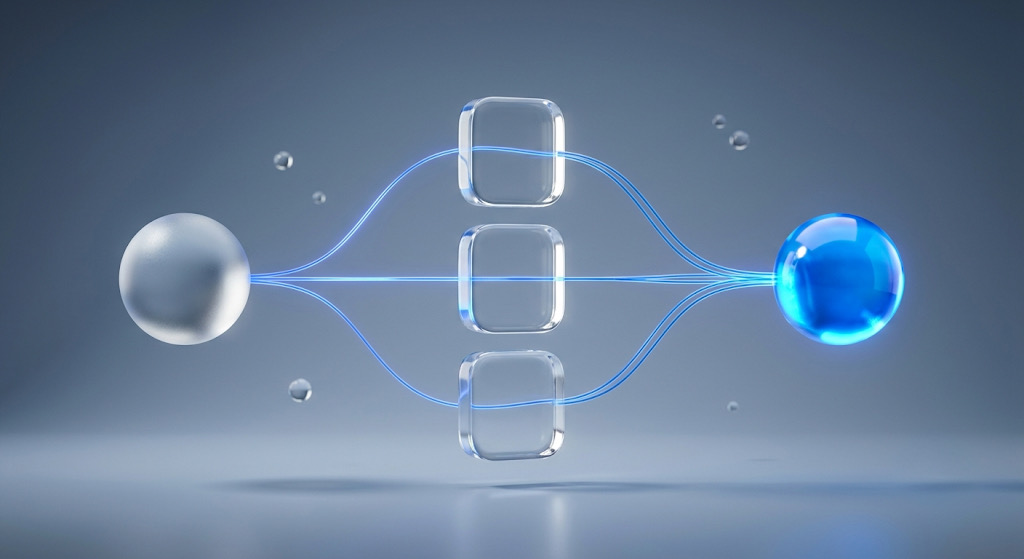
A single AI agent hits a ceiling fast. Give one model the whole job - research the customer, form the hypothesis, design the variation, write the code, judge the result - and quality degrades in a predictable way: the context fills up with everything, so the model is mediocre at each thing. The fix that works in production is the same one that works in human teams: specialists, clear handoffs, and someone checking the work.
We run growth and CRO programs on exactly this structure, with AI agents built into our own platform doing defined jobs inside it. This post is about the patterns: when a team of agents genuinely beats one, how to wire the handoffs, and the failure modes that eat teams who get it wrong.
Why specialists win
Three reasons, and none of them is "more intelligence."
Context isolation. Each agent sees only what its job needs. Our design agent gets the brand's real page, screenshots and design tokens - not the whole project history. Anthropic reported the same thing building their multi-agent research system: parallel subagents with their own context windows outperform one agent trying to hold everything1.
Least privilege. A team of narrow agents lets you give each one only the tools its job requires. Our design agent can read and write files in one folder. Our operations assistant can touch project data but never the filesystem. When an agent has one job, "what could go wrong" becomes a question you can actually answer.
Verifiable handoffs. When work passes between agents as a concrete artifact - a research brief, a mockup file, a block of code - you can check it at the boundary. One giant agent produces one giant output you can only accept or reject.
The pattern that carries our CRO work
Our experiment pipeline is a relay with human gates:
- Deterministic code scrapes the client's live page: screenshots, design tokens, a faithful static copy of the control. No AI involved - reliability work belongs in plain code.
- A design agent produces the control-vs-variation mockup in a sandbox.
- A human approves the design (or asks for another version).
- A code agent turns the approved design into ship-ready variation CSS and JavaScript, plus setup instructions for the testing tool.
- After the test runs, a report agent writes the narrative around numbers computed entirely by code.
Notice what the orchestration is: ordinary application logic. Statuses, versions, approval steps. The agents never talk to each other directly; they communicate through reviewed artifacts. That is deliberate. A large study of multi-agent failures found that most breakdowns come from specification and coordination problems - agents misunderstanding their role, or handing each other bad context - rather than from model weakness2. Deterministic orchestration with typed handoffs removes the failure surface where those coordination bugs live.
When more agents actually help
Research keeps finding that sampling several agents and aggregating beats a single attempt on many tasks3, and our experience maps to three specific situations where adding agents pays:
- Parallel breadth. Auditing 40 landing pages, mining hundreds of reviews for objections, sweeping competitors: fan out identical agents, aggregate, dedupe. This is a scale win, not a smarts win.
- Independent verification. A second agent whose only job is to attack the first agent's output - does this design break the brand? does this code touch anything outside the test? - catches errors the author agent is structurally blind to.
- Genuinely different skills. Research, copy, design and code reviews want different context and different instructions. Forcing them into one prompt makes each worse.
And the honest counterpoint: for a single well-defined task, one agent with good tools is cheaper, faster and easier to debug. Multi-agent systems burn multiples of the tokens a single agent does1. If the work does not parallelize or need independent checks, do not pay the tax.
The rules we operate by
- Orchestrate with code, not vibes. The workflow - who runs, in what order, what gates exist - is application logic, versioned and tested. Agents fill in steps; they do not decide the shape of the process.
- Make every handoff an artifact. Files, structured data, drafts in a review UI. If you cannot point at what agent A gave agent B, you cannot debug it.
- Put humans at the expensive edges. Approval before anything ships to a client's site, their ESP, or their invoice. The cheap middle can be fully automated.
- Give reliability work to deterministic code. Scraping, rendering, validation, math. Agents are for judgment, language and synthesis - the parts code cannot do.
- Start with one agent. Split only when you can name the reason: parallelism, isolation, or verification. "It sounds more advanced" is not a reason.
What this means if you run growth
The teams getting real leverage from AI in growth work are not the ones with the cleverest prompts. They are the ones who redesigned the workflow: specialists with narrow jobs, checkable handoffs, humans at the gates. That is a systems problem, and it is very buildable today.
We wrote up the research behind this properly - orchestration patterns, the failure-mode taxonomy, when scaling agents helps - in our paper on multi-agent LLM systems, with the single-agent foundations in its companion.
If you want this applied to your funnel - an experimentation program run by a team of specialists, human and AI, with the numbers reported honestly - that is our CRO program. And if you want agents like these built inside your own business, start here.
References
- 1.Hadfield, J., Zhang, B., Lien, K., et al. (2025). How we built our multi-agent research system. Anthropic. https://www.anthropic.com/engineering/built-multi-agent-research-system
- 2.Cemri, M., Pan, M. Z., Yang, S., et al. (2025). Why Do Multi-Agent LLM Systems Fail?. arXiv preprint. https://doi.org/10.48550/arXiv.2503.13657
- 3.Li, J., Zhang, Q., Yu, Y., et al. (2024). More Agents Is All You Need. Transactions on Machine Learning Research. https://doi.org/10.48550/arXiv.2402.05120
Related research
Multi-Agent LLM Systems: Orchestration Patterns, Failure Modes, and When More Agents Help
A practitioner review of multi-agent LLM orchestration - orchestrator-workers, pipelines, debate - with a failure-mode taxonomy and evidence on when adding agents pays.
Read the research ResearchTool-Using LLM Agents in Production Business Workflows: A Practitioner Review
A practitioner review of tool-using LLM agents in production: constrained tool design, human-in-the-loop gates, failure modes and evaluation, grounded in a live agency platform.
Read the researchWant a team to run this for you?
See how we help